Rutgers University Projects in Mt. Tabor
12/30/2025
By Christina Wu Bunzendahl
Hello Gardening Enthusiasts! It’s my first time blogging for the Garden Club of Mount Tabor, and I am so thrilled to have the opportunity to tell you about all the exciting Rutgers University projects going on in our little community.
An introduction: I am a 17-year resident of Mount Tabor, in what I call “The Chocolate Cottage” owing to the fact that it’s chocolate brown in color. Long-time Taborites call it “Josie Wilson’s house,” who used to be the president of the Garden Club. I am both a Rutgers Master Gardener and a Rutgers Environmental Steward, meaning that I have taken some courses in horticulture, ecology, and botany and want to put it to use by restoring the woodlands around Mount Tabor.
As we all know, the native flora and fauna of North America are under immense stress due to changes in climate, habitat loss, and human pressure. Mount Tabor was founded as a retreat from all that stress, an oasis, and I’d like to keep it that way. The latest university research finds that healthy systems are resilient systems – this applies to both humans and forests. I can’t personally do much to reverse the course of climate change, but I can do something to make our woodland ecosystems more resilient to change. In this way, I am protecting our little corner of the world. There are three on-going projects associated with Rutgers University going on in Mount Tabor. I will write separate blog posts for each one to give each project the attention and detail that they (and you, as part of the Mount Tabor community) deserve. All three of these projects address forest health with an eye towards long-term viability, resilience, and stewardship. The reason that Mount Tabor continues to be a cooling oasis in a concrete summer oven is because of our immense tree cover. We have old growth canopy trees in our community that are hundreds of years old; this is a rarity in most neighborhoods. These huge trees provide cooling shade, evaporative cooling via their leaves, and absorb an immense amount of carbon dioxide, but our trees are dying. It’s not the fault of any one thing, just a build-up of circumstances that make it hard for them to survive long droughts, punishing heat, hurricanes, freak out-of-season snowstorms, and imported pests. These projects will help to replenish the woodlands around our neighborhood and help maintain the oasis that is Mount Tabor.
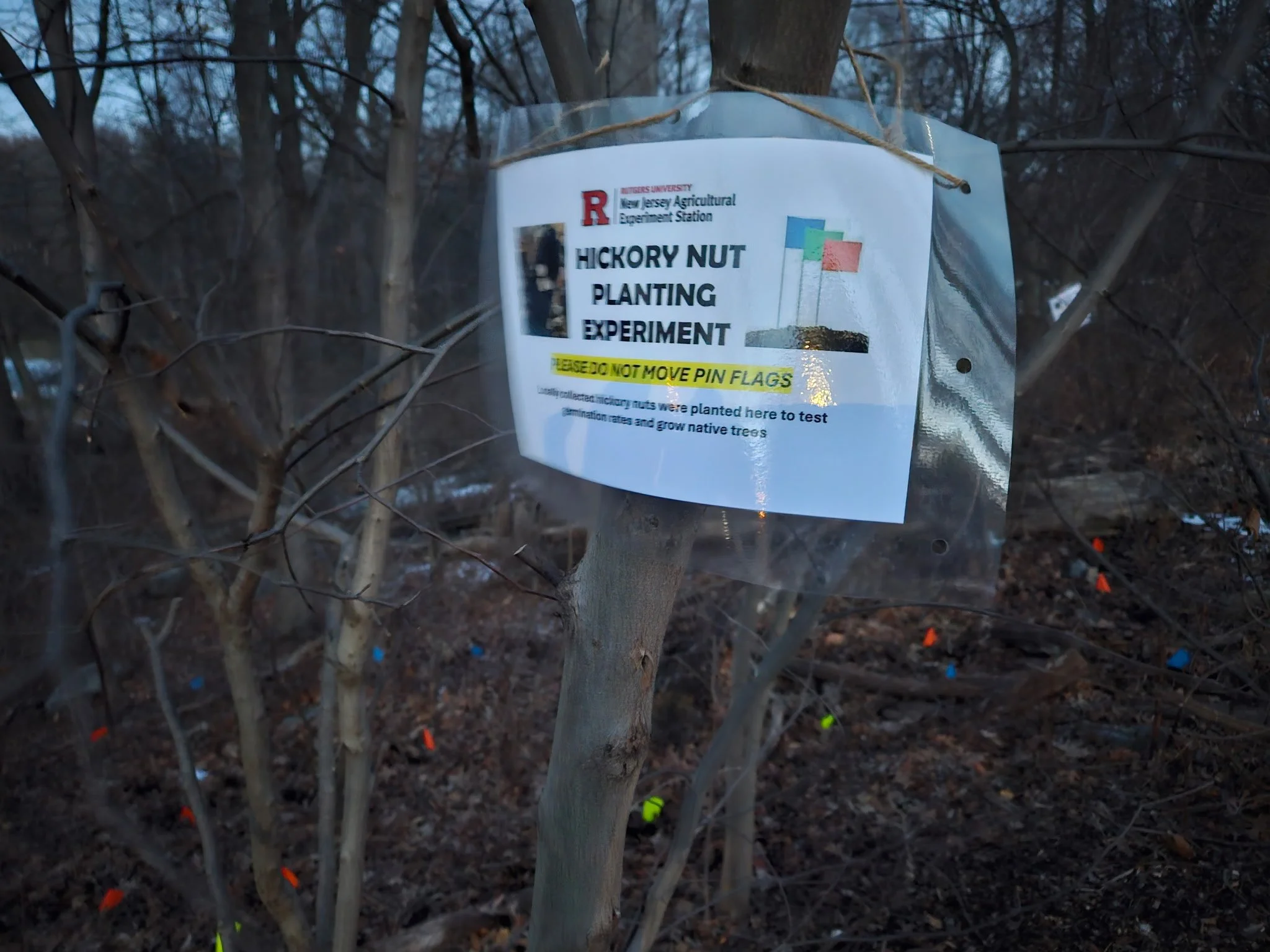
The first project was started in 2023 as a Rutgers Environmental Stewards project, run by Margo Happer (Mountain Lakes resident), called “Grow Your Own Forest.” The idea is that the native trees that have already germinated and started growing on their own have done so, because they belong in that spot. Ms. Happer’s project in conjunction with the Garden Club of Mount Tabor is to protect those trees from deer and other herbivores, so that they can take their places in our forest as future canopy trees. You can find these caged trees on the slopes leading down to our pond area and around the pond itself. The second project was just started last week in December 2025. It builds on the fact that our area of New Jersey, the Highlands eco-region, was once mostly oak and hickory forest. Oak and hickory are slow-growing, long-lived trees that take many generations to establish. To help fill in the gaps where trees are currently dying, and to preclude invasive plants from taking over our native woodland ecosystems, I have started a Mockernut Hickory and Chestnut Oak germination project, led by Jean Epiphan (Rutgers Extension Agent, Morris County).
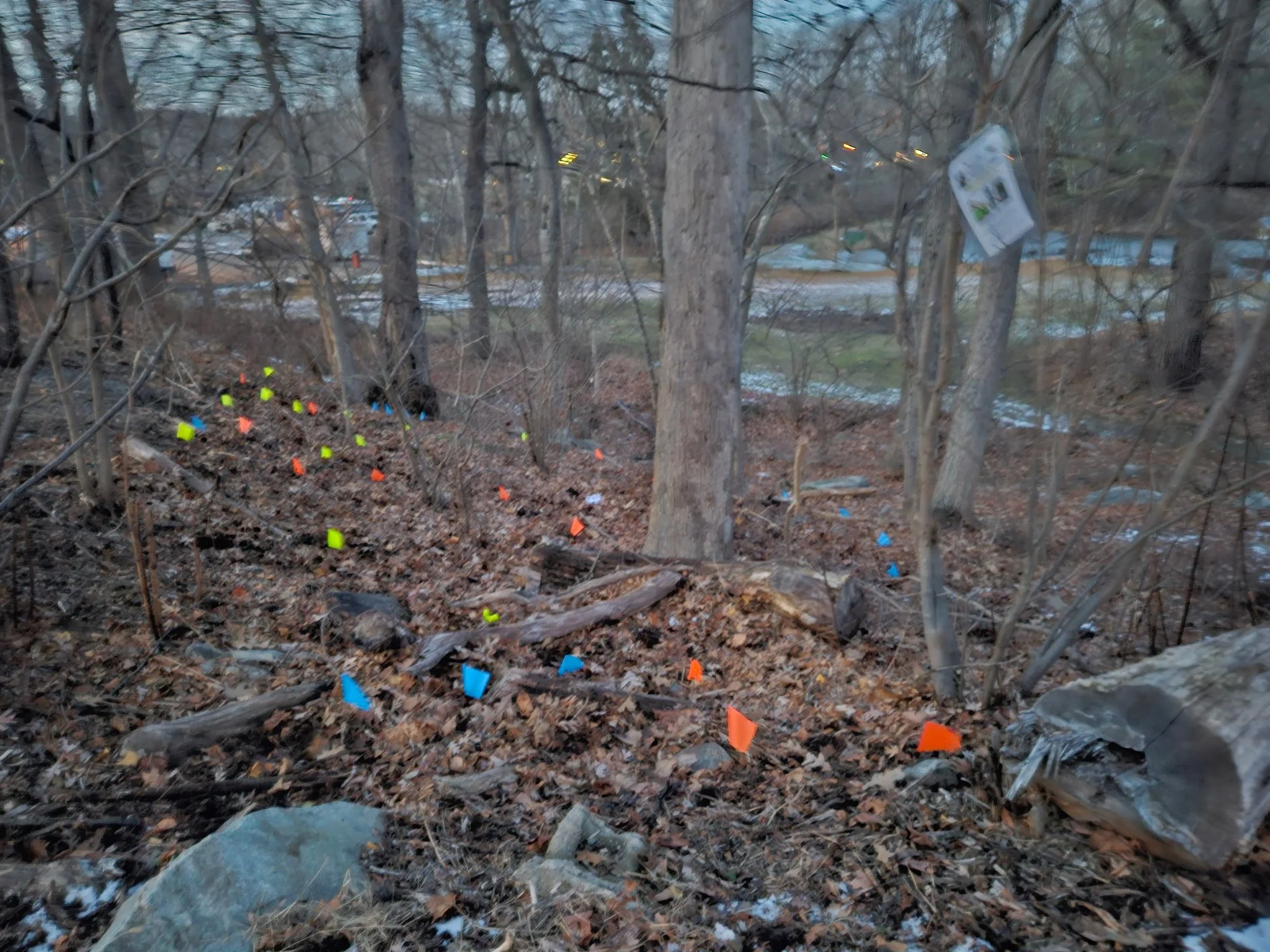
You will find multi-colored flags and signage on the slope at the end of East Morris Avenue indicating where I planted the hickory nuts. The third project is my own Rutgers Environmental Stewards project. It involves restoring the 100ft x 30ft slope between the volleyball court and the pond. That slope is home to an amazing and improbable array of native plants. There are 2 - 20ft+ tall American Elms (which were thought to be wiped out by Dutch Elm disease), and there is a 15ft tall White Ash tree (which were almost entirely killed by Emerald Ash Borer). My plan is to remove the invasive wineberry, Dame’s Rocket, Creeping Charlie, Phragmites, and Japanese Knotweed, and replace them with native shrubs, flowers, and grasses. In the end, the community will be able to learn about native plants and their benefits, and we will be able to certify the area as a Wildlife-Friendly Garden by the National Wildlife Federation.
None of these projects will be complete in a season or even a year. They are a labor of love and do not require funding from the CMA (although every little bit helps!).
To the extent that the Mount Tabor community can and wants to help with these and other restoration projects, your help is most welcome in the form of both manual labor and funding for supplies and materials. I will lead periodic presentations to update the community, and I hope to see you soon!